Tansel Ali
4-Time Australian Memory Champion
From one day away from death to the world stage. I've mastered my mind to achieve the extraordinary—and now I mentor others to do the same.
Pushing the boundaries of what the mind can do.
I have represented Australia at World Memory Championships in London, Malaysia, and Japan—winning four national titles and breaking multiple memory records. Later, I pushed the limits even further by memorising two entire Yellow Pages phone books in just 24 days. Through my international bestselling books, I now translate these extreme mental systems into a vehicle for total achievement.
Hi, I'm Tansel.
I always thought I had a terrible memory, until I learned it wasn't broken, just untrained. That realisation took me from failing university to earning two Master’s degrees, directing TEDxDocklands, and building language learning frameworks with The University of Melbourne and PwC. From playing guitar in a metal band to serving as a Celebrity Crohn’s Ambassador, I didn't just want to break records—I wanted to prove that anyone can achieve the extraordinary with the right system.Learn more about me →
AS FEATURED ON

My work.
I partner with high-level performers, visionary leaders, and champions who are ready to push past their plateau and reach another level. Through personalised mentoring, I provide the cognitive architecture required to rebuild your baseline and achieve your next level of performance. Whether you are recovering from an immense setback, preparing for a world stage, or demanding absolute mental clarity at work, we build the system together.
Let's talk.
Whether you are ready to apply for elite 1-on-1 mentorship, looking to inspire your organisation with a keynote, or exploring a corporate training partnership, let's start the conversation.
I write weekly on memory and mental performance — Read my private notes
Let's start a conversation
About
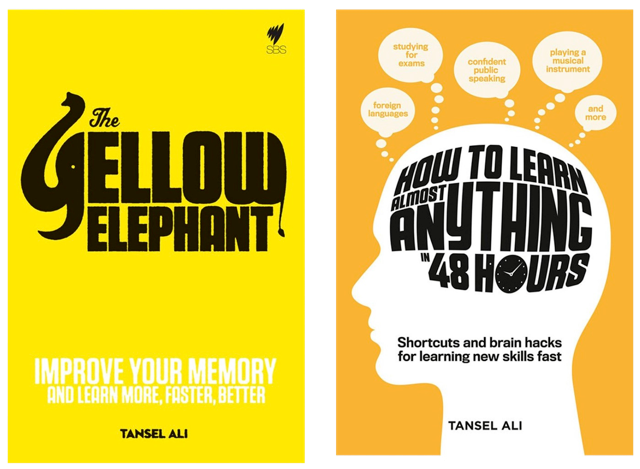
Tansel Ali is an international bestselling author, speaker, and cognitive performance trainer. His journey with the mind began in his twenties during a severe battle with Crohn’s Disease. Faced with immense physical limitations, he discovered memory training and became fascinated by how deliberately training the mind could radically expand what he was capable of achieving.That discovery propelled him to become a Four-time Australian Memory Champion. He represented Australia at the World Memory Championships, shattered national records, and memorised two entire Yellow Pages phone books in just 24 days—proving the mind's limitless capacity. Tansel is the author of two international bestselling books, The Yellow Elephant and How to Learn Almost Anything in 48 Hours.For over 25 years, he has partnered with elite individuals and visionary organisations to elevate their cognitive performance. His work spans private mentorship, keynote speaking, educational projects, and the development of cutting-edge learning systems designed to unlock hidden potential.Driven by a mission to elevate others, he organised and directed TEDxDocklands and the School Mind Games, and co-developed a language-learning framework with the University of Melbourne and PwC. Today, Tansel mentors high-level performers who refuse to settle—guiding them to learn faster, remember more, and achieve the extraordinary.For speaking engagements, media inquiries, or private mentorship, please get in touch here.
Back home
Read my personal story
My story
Hi, I’m Tansel Ali.I used to have a terrible memory. I’d forget people’s names, conversations I’d just had, numbers, and even had difficulty retaining what I’d just read. I had pretty much given up and accepted that I had a bad memory.This acceptance, which I thought was a fact, also affected things like my listening ability, learning new things, and being mindful and attentive on a daily basis. I was absent-minded a lot!Even my bass player in the band I was playing in at the time was constantly frustrated with me, as I could not, for the life of me, remember the notes on the guitar. All he remembers me saying is that I had a ‘shocking memory’.Whilst my bad memory didn’t affect things like my confidence, I felt it did affect my learning ability. I was frustrated. I was failing the one university subject required to obtain my degree, year after year. All the hours of cramming and rote learning, no matter how many hours I spent, didn’t work. I would eventually graduate after three failed attempts.How it startedOne night, watching late-night television, I saw so-called ‘memory experts’ remembering everyone’s name in the audience, memorising long lists of words, numbers, dates, and so on. I thought they were fake and were simply trying to sell their memory tapes. It had to be fake, right? As my memory was terrible, I did not connect.Later on, a friend of mine came up to me and told me he could memorise a random list of forty words in a matter of minutes. I didn’t think he would be able to do it, so I had to test him. After giving him a list of random words, he memorised them all perfectly. Just like the experts on TV.At this point, I wasn’t convinced. I thought he was playing a trick on me. He told me it was no trick and that all he used were memory techniques he had learned from a book. I asked him which book, but he couldn’t remember!This now piqued my interest. Would I be able to do this as well? I found myself Googling memory techniques and came across many great websites and resources. I learned very basic systems and practised them. To my surprise, they all worked!I couldn’t believe all it took was learning a memory technique to show me that my memory was not terrible but, in fact, untrained. As I started to learn more, I was hooked.One day away from deathThen life took a turn for the worse.
I was rushed into hospital. I was in extreme pain. I had an abnormal growth in my stomach and had to be operated on. The surgeon advised me that if I hadn’t had the surgery when I did, I would have died.They cut out part of my intestines, added 31 staples from my chest down to my lower abdomen, leaving a nice scar, and for three months, I lived with an ileostomy bag.The new job I had started had already sacked me by then whilst I was recovering in hospital. I had lost a total of 30-odd kilograms (66 pounds) and was on 20+ pills a day due to my chronic illness.Five years prior to surgery, I was diagnosed with an inflammatory bowel disease called Crohn’s Disease. It had indeed almost spelled the end of me.
Fair to say, life was kicking me in the guts.I needed something to focus on. Something to bring life into a new healing body and mind.
So I continued my quest into memory training. All from my hospital bed.My friend who introduced me to memory would visit me in hospital, and we would chat about memorisation methods. I would be in my hospital bed trying to memorise a pack of cards.Once I’d relearned how to walk and was out of hospital, I was fortunate enough to make it just in time for my university graduation day, ileostomy bag and all. I was slowly getting my life back together at the age of 24.
Recovering at home, I spent quite a bit of time reflecting on life, reading, and getting back to my newfound curiosity about memory techniques.My curiosity grewI was amazed at how quickly the techniques were working for me, despite my terrible memory. I was remembering lists of words and had systems for remembering names and everything else I wanted to do.
As I kept researching and learning more about memory, I came across the Australian Memory Championships.From that point on, my life took another big turn: entering the competition as a memory athlete.The Australian Memory ChampionshipsThe Australian Memory Championships was a memory competition that tested competitors’ memories like no other.There were ten events in a full-day competition, which comprised remembering things like random lists of words, hundreds of digits of numbers, dates and poems, random shuffled decks of cards, and even people’s names and faces.The late Tony Buzan, our mind mapping and memory hero, was there overseeing proceedings along with organisers Bill Jarrard and Jennifer Goddard, who had laid the foundation for memory sports in Australia.The best memorisers in Australia had flown down, and my friend and I were nervous. At this point, I still believed I had a shocking memory and only knew a few memory techniques to help me memorise for the competition.Thinking we’d come last, my friend and I ended up breaking national memory records and finishing 2nd and 3rd in Australia.Before we knew it, the media had picked up our achievements in the competition, and we were on television being interviewed in prime time as ‘memory gurus’. More media interviews followed soon after, then papers, magazines, radio, and then more television.Imposter SyndromeAt this point, I thought I still had a crappy memory, but the techniques made me look a lot better than I was.
That is when I got hit with a good dose of imposter syndrome.Who was I to be a so-called ‘memory expert’ or ‘memory guru’ when all I did was apply memory techniques for the competition? In reality, my memory was still below average.
So I really wanted to do something about it, get better at this skill, and actually feel that I was living up to the guru name.Competing at the world levelSo the following year, my friend and I entered the Australian Memory Championships again, placing 2nd and 3rd. We were much better ‘memory athletes’ this time round and decided to compete internationally at the 2003 World Memory Championships in Malaysia.We were the first-ever competitors to represent Australia, which was exciting.I thought we were definitely going to come last, competing against the very best. The World Memory Championships is a three-day event, as opposed to the shortened one-day affair of the Australian Memory Championships. We had events that involved one hour of memorisation instead of the usual five minutes.Nevertheless, despite our lack of experience, we gave it a good crack.
Both of us did really well. Personally, I had broken five personal best memory records and had a total of six Australian memory records (out of 10 events). Something which had not been achieved before.I had even beaten my memory hero and eight-time World Memory Champion Dominic O’Brien in two events, Names & Faces and random/historic dates.I also achieved a Grandmaster of Memory Norm (a special international memory achievement) for memorising a randomly shuffled deck of cards in under three minutes. A feat which not many competitors had achieved back then.Fair to say, it was a successful trip, and it made me realise that someone like me with a ‘shocking memory’ could actually learn to remember anything I wanted.I just had to learn the skills and apply them.The EpiphanyThis led me to believe that if I could achieve what I had achieved, then what about everyone else?So I thought it was incumbent upon me to show these techniques to others, so they too may see results and experience transformation in their lives.But where would I even begin?I started working with students, as I thought something like memory techniques would help them learn a lot faster and better. I ran student workshops, presented in schools, and did a lot of personal coaching.At the time, I had no idea what I was doing. I just wanted to help as many people as I could, so I spent a lot of my time working for free and donating my time, volunteering, and making sure the techniques reached the people who needed them the most.The results were amazing.I couldn’t believe the impact that these skills were having on students, teachers, and the whole learning and education community.Dyslexia caseI remember one family who had heard of me asking me to come and coach their dyslexic/ADHD children.These children were being driven by their parents to a ‘memory specialist’ on the other side of town, over an hour’s drive, every week, for a whole year.Their parents were paying a lot of money each visit, along with travel costs.I went to their house and immediately tested their children. I gave them the most basic words to spell, and they messed up every single word. Not one correct.
I thought, “Wow, these kids have been travelling for a whole year to a specialist. What had they actually learned?”I felt for the parents, as it was such a burden on them, yet they kept at it in the hope that somehow their children would change.Well, it seems that they obviously hadn’t.After my initial test, I showed the children some memory techniques to apply for remembering how to spell certain words.I gave them a new test with different words, and sure enough, they memorised them all perfectly.The kids and parents were shocked.
In the space of twenty minutes, their memory, and more importantly, their learning, had transformed.It gave me a whole new level of appreciation for memory techniques, and I knew I had to get this out to more people.Professional exam caseExaminations in any learning endeavour tend to be difficult to deal with.However, one person came to me with quite an odd request I’d never received before. It was to pass the Master Sommelier exam. This is considered by many to be the most difficult exam to pass in the world.
I asked my client when he was sitting the exam, and he held his breath and said, “In two months’ time.”I didn’t know why he came to me at the last minute, but I thought there might still be a chance, so we set out to pass an exam I had no idea about.My client was stressed because if he didn’t pass the exam this time round, the situation was going to be very dire for him, so training his memory was the only option.I knew memorisation was simply not enough to pass the world’s hardest exam, so we set out strategies, systems, processes, and mental maps that assisted with not just remembering, but understanding a very large amount of information. And not just in English, but in multiple languages.After only one month, my client knew everything. In the second month, all he did was revise.He flew to Austria to sit the exam amongst several others.One week later, I received a text message from him saying he was the only one who passed.I was ecstatic for him, and it demonstrated the true power of memory skills.I’ve since helped individuals pass the BAR exam, medical, IT, finance, and even police exams with amazing results. One of my high school students even went from averaging 70s to achieving a top 5% result in Australia (90s) in her final year of studies.Keynote Speaker CaseAs my understanding of the power of memory grew, I knew it could also be utilised for public speakers, since I was already one.TEDx speakers, I’ve noticed, have more fear than most. That is because their talks are broadcast to millions watching on YouTube, and if the talk is ‘good’, it can literally be seen by millions of people.One of those speakers came to me freaking out about their talk.They handed me a six-page script, which I instantly tore.The look on their face was like I had ripped through their heart.After spending only twenty minutes on a call showing them the techniques, this person not only memorised their talk at TEDx, but they also became the star of the day, having a massive impact on their audience.Memory wasn’t just about remembering information. It was about creating a memorable impact on those in the audience.I felt a sense of joy for the person delivering the talk, but even more so, I realised memory wasn’t just about remembering things.It was about connecting with people and creating an impact.Reaching Greater HeightsSo the more I trained and learned about memory techniques, the better I understood how to apply them to many areas of life.Remembering speeches perfectly, learning languages, passing professional exams, managing time, killing procrastination, boosting mental athletic performance, even reducing stress and anxiety, all with the use of memory techniques!Over the years, I was regularly invited to speak to thousands internationally, work with some of the largest organisations, and coach massive celebrities and executives to empower them with super-powerful memory and learning abilities.You can check out some of my client success stories by clicking here.Writing my first bookMost people would have no idea that memory techniques could help with managing stress or earning a higher income. Yet these all require the mind skills to make it happen.Eventually, I wrote my first memory book, The Yellow Elephant. It was my greatest achievement. Not because I had written a book, but because I had poured ten years of my heart and soul into a package that I knew would benefit humanity.Two years later, I followed it up with my next book, How To Learn Almost Anything In 48 Hours. Both would eventually go on to become bestsellers. More importantly for me personally, they would go on to help thousands around the world.The success of the books would eventually land me memory expert roles in various TV shows, documentaries, newspapers, magazines, etc.It also led me to speaking around the world on a topic where only years ago I felt useless. I had indeed turned into one of those experts I saw on television and was sceptical about.The World’s First School Mind Games CompetitionI wanted to introduce memory techniques into schools, but in a way where the skills were actively applied and not just viewed as a one-off presentation.Inspired by the initial success in schools, I initiated the world’s first School Mind Games competition.
I trained a few fellow enthusiasts as my trainers, and we went into participating schools and ran workshops on memory, speed reading and mind mapping.When competition time arrived at the end of the year, the students, who were thirteen at the time, read my first book, The Yellow Elephant, a 200-pager, in only 10 minutes.Then they mapped out all the book’s contents on a wall, memorised its entire contents chapter by chapter, and presented it back to the audience and judges in great detail.
As a bonus, they also memorised one of my student’s 11-minute TEDx talks, word for word!All this in the space of a couple of hours.Aside from all the shock and media publicity we gained, the students and teachers had knowledge and confidence that would reshape their entire learning and education.Memory techniques had indeed changed their lives for the better.Looking back I never would have gotten into this if it wasn’t for discovering a system that worked and busted the myth I had in my mind about having a bad memory.
Maybe it was by chance. Maybe it was luck or timing. Nevertheless, I did something about it.And my aim was to help people who had once suffered like I did with a terrible memory experience the same transformation.So for over 20 years now, I’ve been helping individuals create a better life through memory techniques.I now know that it is not simply about ‘remembering’ things, but having a greater sense of ‘connection’ to the life we want to live.That’s my story.If you think you have a bad memory or you want to challenge yourself, then there is always something you can do.Reach out and let’s have a chat.
It might just change your life too.
Back home
Get in touch